
Production Only
Printing, cutting, fabrication, painting, finishing, assembly, labeling, and packaging begin with an approved production specification.
Production-planning guide for a proposed Tukwila project—not a branch, delivery, or field-service page.
Prepare Tukwila production inputs after checking the visible-sign permit rule, any exception, and state-road context.
Production and fabrication only. The customer or qualified project team confirms field dimensions, site conditions, approvals, mounting, access, and installation.

Printing, cutting, fabrication, painting, finishing, assembly, labeling, and packaging begin with an approved production specification.
The customer or qualified project team verifies the parcel, governing authority, property rules, permits, and any professional review before release.
Finished components can be labeled and packaged to the approved schedule; field measurements, mounting, access, and installation remain outside shop scope.
Banners made from approved artwork and final specifications.
Graphics produced for customer or third-party application.
Components made to the approved production brief.
Seattle Sign Squad does not perform site surveys, field measurements, permit handling, code review, engineering, electrical work, mounting design, installation labor, or installer scheduling.
The customer or qualified project team must resolve those items and provide the final approved inputs used for production. Start with the artwork setup guide and installer-ready handoff requirements.
Address to approved specification
For Tukwila, begin by confirming whether the proposal is a visible sign or alteration that follows the ordinary permit path, whether a documented exception applies, and whether state-road context introduces another authority. Those questions can affect the size, placement, sign form, or supporting information the project team approves. Resolve them before the shop treats a concept elevation as a fabrication-ready drawing.
The production brief should describe both the finished appearance and the physical change being made. For a new tenant sign, identify the approved envelope, component build-up, copy, colors, and attachment interface. For a reface or alteration, distinguish the retained cabinet or support from every new face, trim, graphic, or dimensional element. For banners and applied graphics, record the final display size, viewing direction, finishing, surface, and duration information established by the project team.
Supply the approved sign category, overall size, projection or support relationship, construction depth, materials, finish, and final copy. Include a dimensioned elevation and qualified attachment information. If the property has a tenant-sign program, reconcile that program with the municipal review before releasing shop drawings.
State precisely what remains and what changes. Verify cabinet openings, face shape, retainers, material thickness, illumination environment, trim, and orientation. If size, support, projection, or attachment changes, obtain the additional approved construction inputs instead of quoting the work as a simple graphic replacement.
Define the finished dimensions, single- or double-sided artwork, hems, pockets, grommets or other requested finishing, surface type, viewing side, panel overlaps, and application sequence. The customer or installer should separately confirm display placement, hardware suitability, access, and any time-limited conditions.
Drawing and handoff coordination
A Tukwila alteration package should preserve the approved scope in a change matrix. List the existing component, the proposed change, and whether copy, face, size, support, illumination, projection, or attachment is affected. Add the confirmed exception or authority decision when relevant, including any state-road context resolved by the project team. Review the matrix against the quote and proof so a new trim piece, enlarged face, or changed support is not introduced as an undocumented shop adjustment.
For banners and applied graphics, coordinate finishing with the actual third-party display or application plan. The printer needs the final hem, pocket, grommet, overlap, bleed, panel order, and viewing direction; the installer needs piece IDs and a scaled layout. If the support or surface remains unverified, keep it as an open field item and avoid locking an interface that may not fit. Pack graphics in application order and protect registration marks, finished faces, and labeled edges.
Record the final dimensions, copy, artwork revision, material, finish, construction, quantities, and every qualified field interface that affects production.
Check scale, critical details, seams, edges, patterns, component breakdown, color references, and labels—not only a reduced visual proof.
Match piece marks, protective layers, patterns, loose components, and packing groups to the approved sign IDs and third-party installer sequence.
Before approving production, use this city-specific list alongside the current official source and the project team's final field information.
Official local context
Tukwila generally requires a permit for visible signs and many alterations unless an exception applies. State-road context can also affect a proposal.
The project team should verify the current rule and any additional authority before approving sign type, dimensions, artwork, and attachment information.
Production gate: Confirm the current City permit path, any exception, and whether state-road context affects the exact proposal before production.
Supports: Visible signs and many alterations generally require a permit unless excepted; state-road context can matter.
Checked:
Materials and finished details
Use these sign and process details to discuss material, finish, legibility, and handoff requirements. The images illustrate production capabilities; they are not city-location claims.
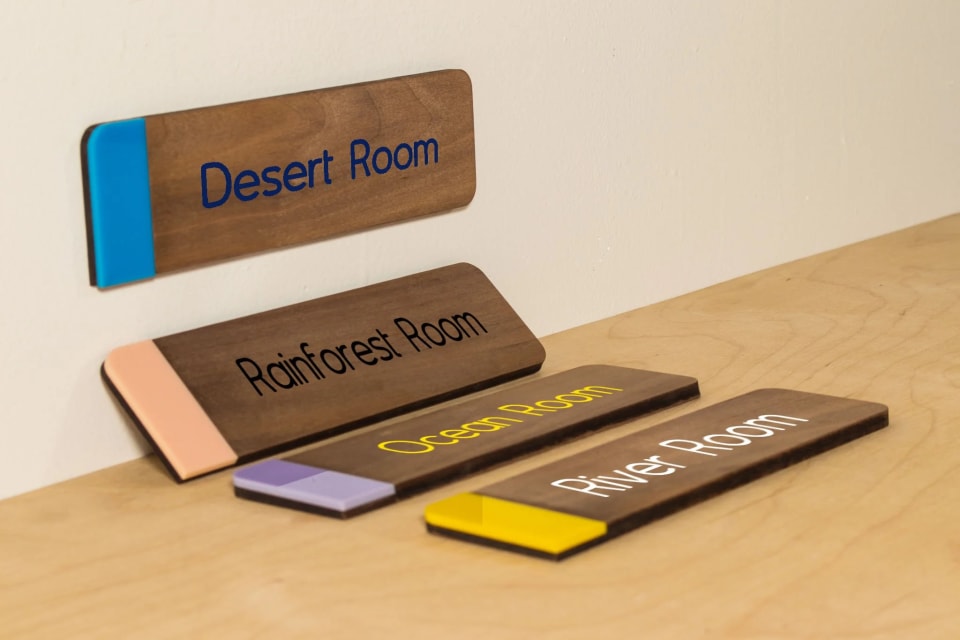
The project team should use the current City rule to classify the proposal. For shop planning, describe every physical and graphic change—face, copy, size, trim, support, projection, illumination, or attachment—so the quote does not assume that a broader alteration is only a reprint.
The recorded City source indicates that state-road context can matter. The customer or responsible project team should identify any additional authority and resolve the approved placement and dimensions before final production. The shop does not determine roadway jurisdiction.
Provide final size, quantity, viewing distance, single- or double-sided construction, artwork scale, material and opacity, edge finishing, requested grommet or pocket layout, and packaging labels. The customer or installer remains responsible for support selection, access, and safe display.
No. This is a production-market guide for orders connected with Tukwila; it does not claim a branch, staffed office, local crew, pickup point, delivery route, or field-service location.
Send the approved product, quantity, final dimensions, artwork, material, finish, exposure, packaging, and installer-handoff requirements.
Production only. The customer or qualified project team handles field verification, governing approvals, code compliance, engineering, access, mounting, and installation.